Venezuelan Arepas
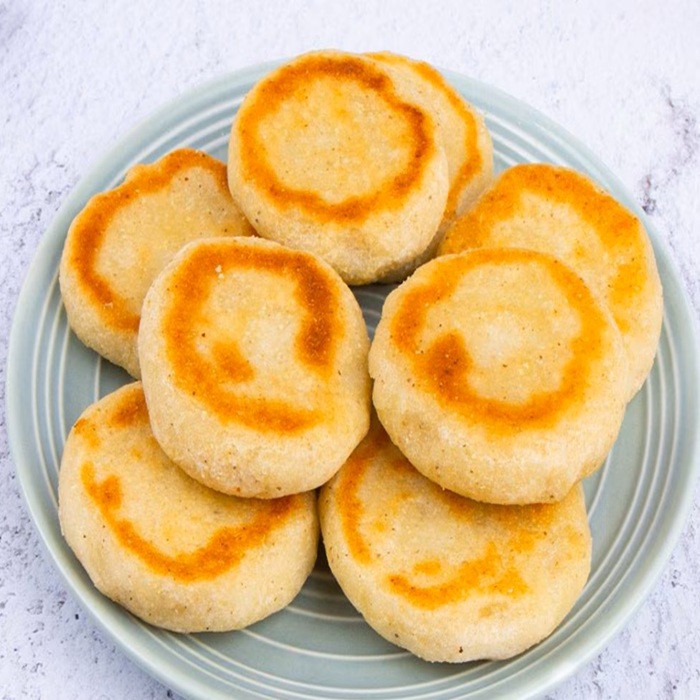
Venezuelan Arepas is a classic Venezuela side that holds a distinguished place in traditional cooking. Celebrated for its wholesome ingredients and time-honored preparation, this dish brings authentic regional character to the home kitchen.
Carefully prepared featuring Cornmeal, the ingredients are simmered and seasoned to achieve a satisfying depth of flavor. The cooking process allows natural aromas to develop, ensuring each portion is both hearty and flavorful.
Serve as an enticing appetizer with complementary dipping sauces or as an accompaniment to a hearty main course.
If you enjoy authentic Venezuela cooking, be sure to also explore our recipe for Venezuelan Turnovers.
Rate this recipe
Ingredients
- Cornmeal2 cups
- Water2 1/2 cups
- Salt1 tsp
- Vegetable Oil1 tablespoon
Step-by-Step Instructions
28 stepsInteractive Cook Mode: Click any step or circle to check it off as you cook.
Preheat oven to 410° F.
Pour the water into a large bowl.
Make sure it is room temperature.
Add the salt.
Blend well with a mixer, fork or spatula to make sure it dissolves well.
While you continue to beat the mixture, slowly add the corn meal—a little bit at a time.
Once all the flour is added, keep mixing until the corn meal, water and salt are thoroughly blended and dissolved.
Set aside the masa in its bowl.
Let it rest for 5 minutes so that the flour is thoroughly hydrated.
This type of corn flour does not have any gluten, so it doesn’t need to be kneaded.
The masa should be smooth, firm yet malleable.
While waiting for the 5 minutes’ rest, heat your budare (or comal, griddle, cast-iron pan or non-stick pan) over medium heat.
Coat with a little bit of the oil.
Fill a small bowl with water to wet your hands to make the arepas.
Take about 2 Tbsp of the masa in your damp hands.
The masa should fit easily in your palm so that it is easy to shape into a small ball.
Cross your hands, so that one is on top of the other, with the masa ball between them.
Rotate your right hand in a circle, so that you are at the same time both pressing the masa into a flat disc and keeping its round shape.
arepa making
The last step in shaping your arepa is to quickly pass and lightly press the masa disc from one hand to the other until it is about ¾ of an inch thick and 4 inches wide.
Smooth the edges with your fingertips (quickly dip them into the water bowl first) so that they stay as round as possible and without cracks.
arepa making
Place your arepas in batches on the preheated surface of your budare griddle or nonstick pan.
Let each side turn golden, about 4 to 5 minutes per side.
Check them often so that they don’t burn.
Once they are nicely browned on both sides, place the arepas on a baking sheet in your preheated oven for 10 minutes.
They should be somewhat puffy, so that if you tap an arepa lightly on top, it will sound like you are tapping an empty box.
Serve arepas hot, whether you stuff with them with your choice of fillings or serve solo to accompany your favorite Venezuelan guiso or stew.
👨🍳 Chef's Culinary Notes
Cultural Heritage
Venezuelan Arepas carries a rich culinary tradition rooted in regional home cooking. Developed over generations, the recipe highlights wholesome local ingredients prepared with time-honored kitchen techniques.
Dietary Substitutions
For a richer sauce, replace a portion of the water with homemade bone broth, vegetable stock, or a splash of dry wine or red wine vinegar to cut through richness.
Chef Technique Tips
Take the time to thoroughly sear and brown cornmeal in batches before adding the braising liquid. The caramelized fond deposited on the bottom of the pot dissolves into the stew, providing depth and body that cannot be rushed.
Recipe Feedback & Reviews
Have you tried making this recipe? Share your experience, modifications, or tips with fellow cooks!
Please log in to leave feedback on this recipe.
Community Feedback (0)
No feedback yet. Be the first to share how this recipe turned out!